

Blog
Welcome to Hervival's 'Her Well-Being Haven' Blog— your go-to space for women's health, holistic wellness, self-care, and mental well-being. Join us every Monday & Wednesday for Monday Mantras offering seven soulful mantra affirmations to inspire you each day of the week and Wellness Wednesday brings insightful health-focused blog articles every week. Fuel your journey with impactful insights and embrace a balanced, thriving life!

Emotional Regulation Tools for High-Pressure Leaders
Emotional regulation tools have quietly become one of the most essential leadership skills of our time. In fast-moving workplaces, leaders are expected to make clear decisions, hold emotional tension, support teams, and remain composed, often all within the same hour.
Yet composure is rarely about personality.
It is about practice.
And the leaders who learn to regulate, not suppress, their internal state are the ones most able to lead with steadiness, clarity, and long-term resilience.
Why High-Pressure Leadership Demands More Than Willpower
Pressure alone does not create strong leaders.
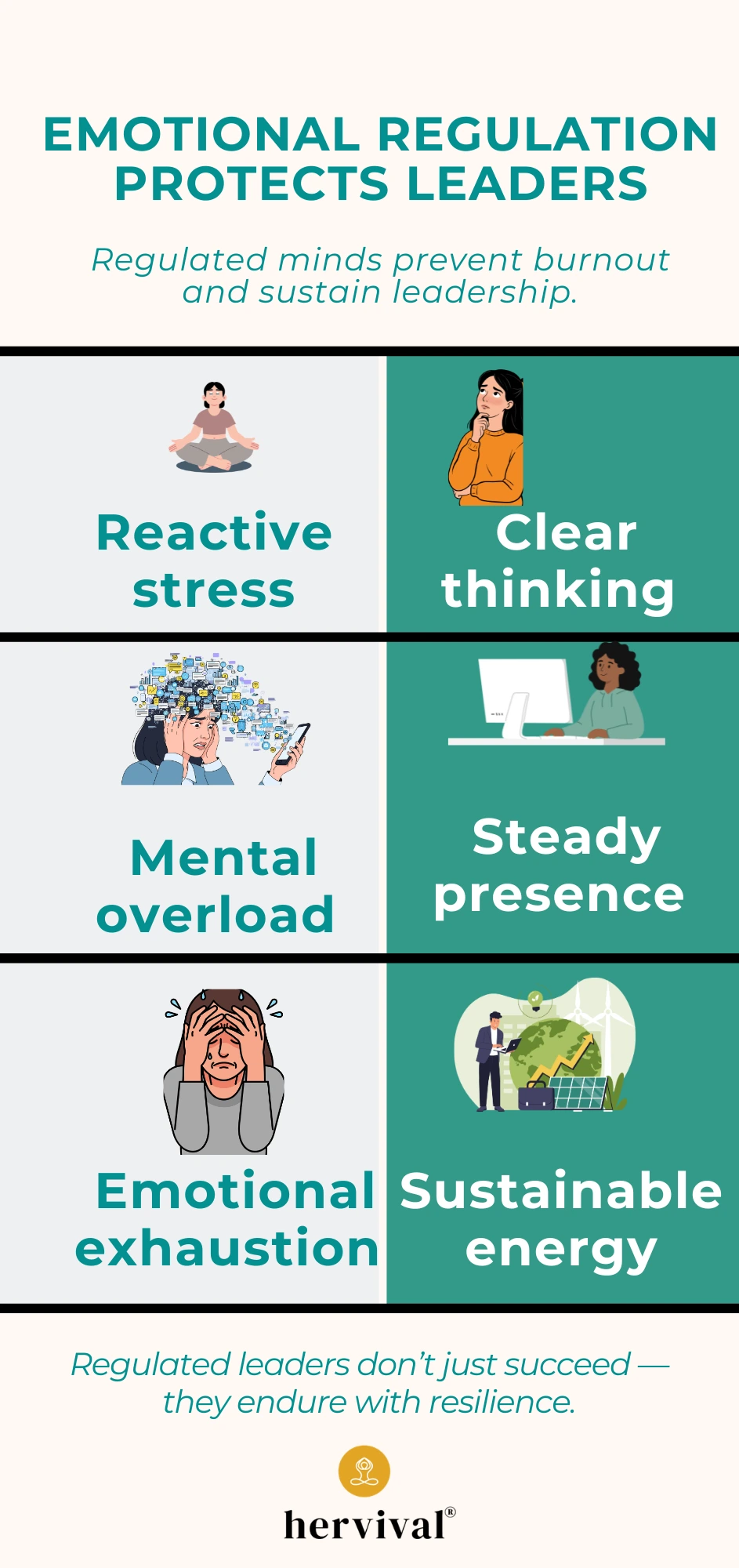
In fact, chronic stress can reduce activity in the brain’s prefrontal cortex, the region responsible for reasoning, judgment, and impulse control. When this happens, leaders become reactive instead of responsive.
Research in neuroscience and psychology consistently shows that regulated emotional states improve decision-making, social connection, and cognitive flexibility (Davidson & McEwen, 2012).
This is why emotional regulation is not a soft skill.
It is a strategic leadership capacity, where calm thinking shapes wiser outcomes.
A Practical Framework of Emotional Regulation Tools for Leaders
Rather than one technique, regulation is best understood as a system of supports, cognitive, physical, relational, nutritional, and resilience-based.
Below is a structured approach leaders can actually use.
Cognitive & Psychological Emotional Regulation Tools
The first layer of regulation begins in the mind.
Mindfulness and short-breathing meditations help interrupt automatic stress responses, allowing leaders to return to the present moment rather than spiraling into urgency. Even brief practices like 4-7-8 breathing or body scans can reduce tension within minutes.
Cognitive reframing adds another dimension.
When leaders reinterpret stressors as challenges rather than threats, the nervous system shifts from fear to focus.
Self-assessment tools such as journaling or emotional-intelligence checklists deepen awareness of triggers and patterns. This reflective work echoes the gentle self-reconnection; clarity begins internally before it appears in leadership.
Visualization then allows leaders to mentally rehearse calm responses before high-stakes conversations occur, turning composure into preparation rather than luck.
Physical & Somatic Emotional Regulation Tools
Leadership stress is not only mental; it is stored in the body.
Breathing practices like box breathing or diaphragmatic breathing activate the parasympathetic nervous system the body’s natural calming response. Movement, whether stretching between meetings or walking discussions, releases accumulated tension and restores circulation to the brain.
Progressive muscle relaxation adds another powerful reset, teaching the body the difference between tension and release.
These physical tools and daily practices quietly protect long-term clarity.
Social & Relational Emotional Regulation Tools
No leader regulates alone.
Active listening slows conversations, reducing emotional escalation.
Empathy mapping helps leaders understand team emotions without absorbing them.
Emotionally intelligent feedback frameworks transform difficult conversations into trust-building moments rather than stress triggers.
This relational steadiness reflects the core message of Balanced Leadership: Work, Wellbeing, and Purpose that sustainable leadership is always both internal and interpersonal.
Nutrition as a Foundation for Emotional Regulation
Regulation is also biochemical.
Foods rich in tryptophan, such as oats, bananas, and turkey, support serotonin production and emotional stability. Omega-3 fatty acids from fish strengthen mood regulation, while magnesium-rich leafy greens help calm anxiety responses.
Equally important is what leaders reduce: excess caffeine and processed sugars, both of which can amplify nervous-system reactivity and mood swings.
Nutrition, in this sense, becomes a quiet leadership tool one rarely discussed, yet deeply influential.
Resilience Practices That Sustain Regulation Over Time
Finally, emotional regulation must be maintained, not just practiced occasionally.
Micro-breaks of 2 to 5 minutes allow the brain to reset its focus.
Gratitude journaling shifts attention toward stability rather than threat.
Sleep, recovery routines, and emotional culture tools within teams reduce friction before stress escalates.
These resilience rhythms mirror the supportive philosophy behind Why Women Need Support, Not More Pressure, reminding us that endurance alone is never the goal; sustainability is.
From Reactivity to Responsive Leadership
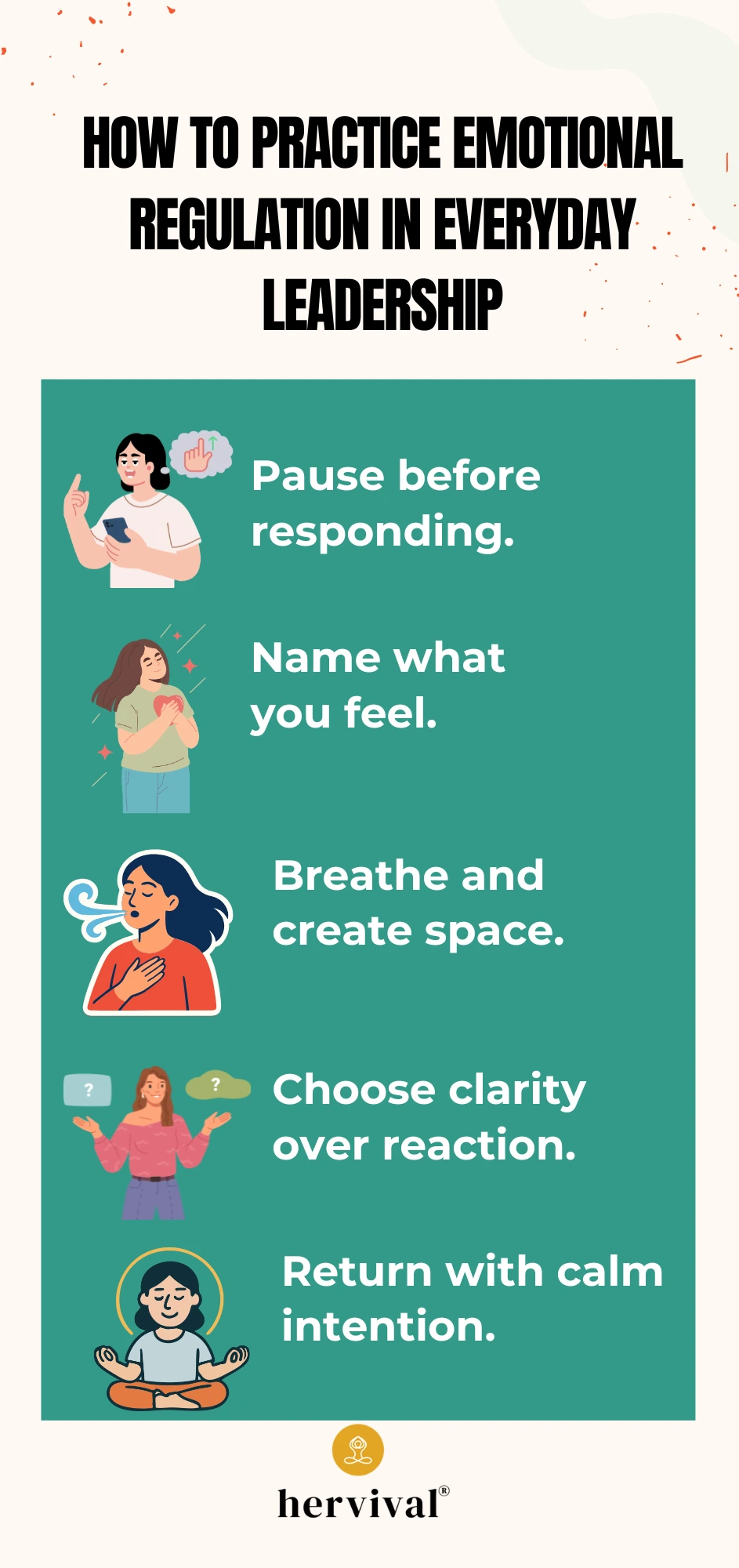
When practiced together, these Emotional Regulation Tools create a profound shift:
From urgency → to clarity
From tension → to steadiness
From survival → to sustainable leadership
And over time, this shift does more than calm individual leaders.
It shapes healthier teams, wiser decisions, and more humane workplaces.
In Conclusion
High-pressure leadership will likely remain a reality.
But chronic dysregulation does not have to be.
With consistent Emotional Regulation Tools, leaders can think clearly in difficult moments, protect their well-being, and lead in ways that are both strong and sustainable.
Calm, after all, is not the absence of pressure.
It is the presence of regulation within it.
If you’re seeking calmer, clearer, and more sustainable leadership, you’re warmly invited to subscribe to the Hervival Newsletter.
Research & References
Davidson, R. J., & McEwen, B. S. (2012). Social influences on neuroplasticity: Stress and interventions to promote well-being. Nature Neuroscience, 15(5), 689–695.
Harvard Business Review. (2021). How burnout affects performance and wellbeing.
World Health Organization. (2022). Mental health at work.

Become a part of Our Holistic Wellness & Self-Care Community! Join our membership TODAY!

Try all premium features for 7 days. Cancel anytime, or continue with your selected plan.
© 2021-2025 Hervival® is a trademark under Global Thrive Enterprise LLC . ©2025 Hervival. All Rights Reserve.