


Soulful Mantras
Discover serenity and healing through powerful soulful mantras every monday for women to get through their impactful week. Embrace your inner strength and embark on a transformative journey of self-discovery.

Energy Management for Leaders: Beyond Time Management
Energy management for leaders starts with a simple realization: managing every minute of your day does not guarantee you will use those minutes well.
You can have a perfectly organized calendar and still end the day mentally exhausted. You can complete every task on your list and still feel like you have nothing left for yourself, your family, or the people you lead.
For years, leadership advice has focused heavily on time management, productivity systems, and doing more in less time. But leadership requires more than available hours. It requires attention, emotional capacity, physical stamina, creativity, patience, and the ability to make thoughtful decisions under pressure.
That is why the next evolution of sustainable leadership is not simply managing time better. It is learning how to manage energy intentionally.
Why Time Management Alone Isn't Enough
Time is fixed.
Everyone receives the same 24 hours in a day. But the amount of energy you have during those hours can change dramatically.
You might have an hour available at 9 a.m., when your mind is clear, and another hour at 4 p.m., when you are mentally drained. The clock says both hours are equal. Your body and brain do not.
This is where time management for leaders can fall short.
A calendar can tell you when something needs to happen. It cannot tell you whether you have the mental, physical, or emotional capacity to do it well.
Imagine scheduling three difficult meetings back-to-back, followed by strategic planning and a performance conversation.
Technically, everything fits.
But does your energy?
Effective leadership requires recognizing that capacity matters just as much as availability.
What Is Energy Management for Leaders?
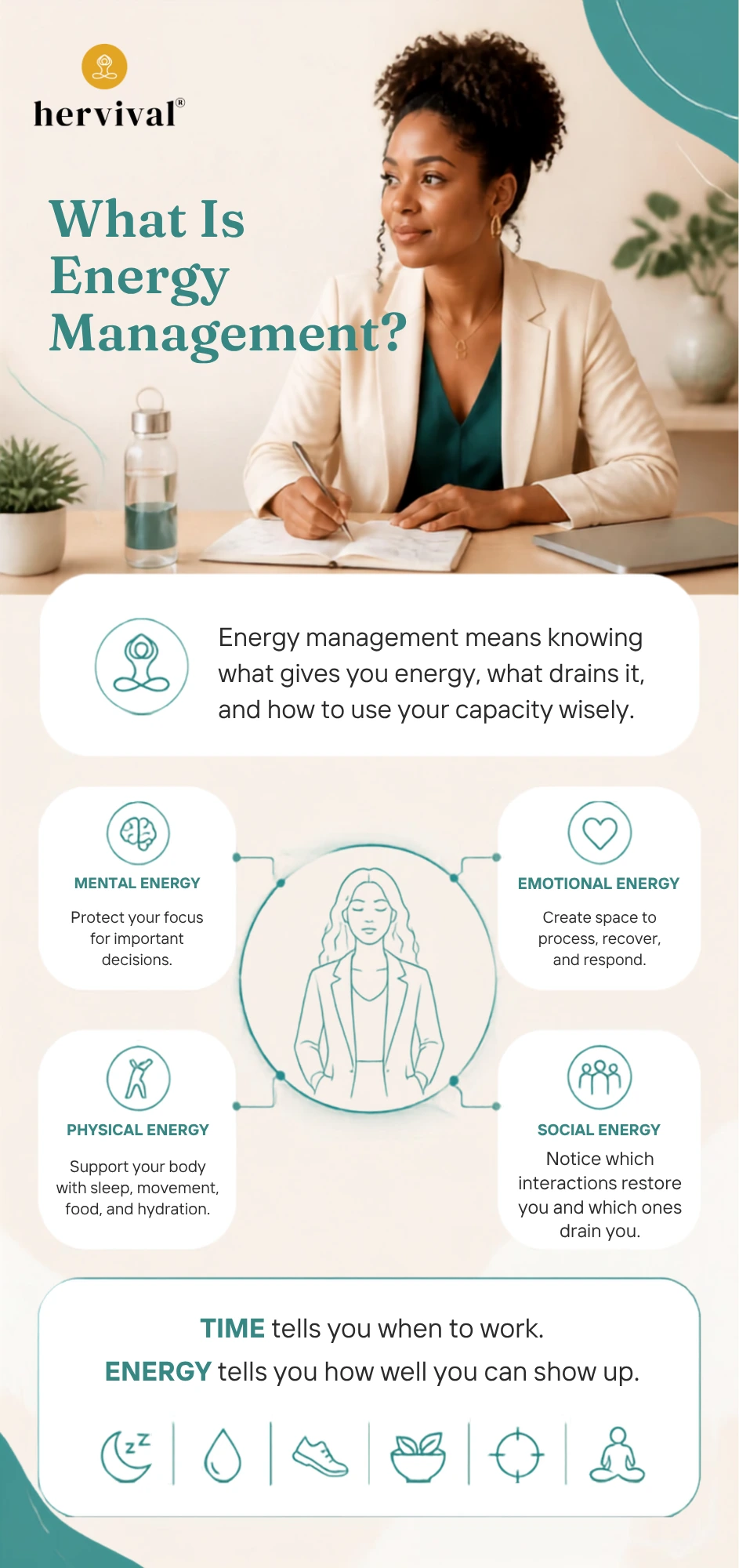
Energy management for leaders means intentionally protecting, restoring, and directing the different forms of energy you need to lead effectively.
It involves understanding what drains you, what restores you, when you perform at your best, and which activities deserve your highest level of attention.
There are four important areas to consider.
1. Physical Energy
Your body provides the foundation for everything else.
Sleep, nutrition, hydration, movement, and recovery influence how effectively you think and respond throughout the day.
When you consistently operate on poor sleep, skipped meals, dehydration, or prolonged inactivity, leadership becomes harder.
2. Mental Energy
Mental energy supports concentration, creativity, problem-solving, and decision-making.
Constant notifications, multitasking, unnecessary meetings, and task switching can quietly consume this resource.
Protecting mental energy may mean creating periods of uninterrupted focus rather than filling every available space in your calendar.
3. Emotional Energy
Leadership involves people, and people involve emotions.
You may need to manage conflict in one meeting, reassure an employee in another, negotiate with a client, and make a difficult decision before lunch.
That emotional labor requires capacity.
Emotional wellbeing in leadership, therefore, deserves the same attention as productivity.
4. Social Energy
Not every interaction restores you.
Some conversations leave you energized and connected. Others leave you emotionally depleted.
Understanding your social energy can help you create healthier boundaries around meetings, networking, collaboration, and constant availability.
Your Calendar Is Not an Energy Map
One of the biggest mistakes leaders make is assuming that an empty calendar means they have capacity.
It doesn't.
Your calendar tells you what you have committed to. It does not tell you how you will feel when those commitments arrive.
Instead of asking only:
"When can I fit this in?"
Try asking:
"When will I have enough energy to do this well?"
That small change can completely alter how you structure your workday.
For example, if strategic thinking requires your highest concentration, schedule it during the part of the day when your mind is clearest.
Save administrative tasks for periods when your cognitive energy naturally dips.
This is not laziness.
It is strategic energy management.
The High-Performer Trap: When Exhaustion Looks Like Productivity
Many ambitious leaders have learned to associate exhaustion with commitment.
If you're tired, you must be working hard.
If you're constantly busy, you must be productive.
If you need rest, perhaps you haven't done enough.
This mindset can be particularly dangerous because it makes depletion feel like evidence of success.
But exhaustion is not a leadership metric.
You can work for 12 hours and accomplish less than you could have in 6 focused hours with adequate recovery.
Sustainable productivity asks a different question:
How can I produce meaningful results without continuously consuming the energy I need to keep going?
That shift moves leadership away from hustle and toward sustainability.
Protect Your Peak Energy for High-Value Work
Not every task deserves your best energy.
This is one of the simplest changes leaders can make.
Your highest-energy periods should ideally be reserved for work that requires:
Strategic thinking
Complex decision-making
Creative problem-solving
Important conversations
Vision-setting
Leadership planning
Lower-energy periods can be used for:
Administrative work
Routine emails
Filing
Scheduling
Simple follow-ups
You are not trying to make every hour equally productive.
You are matching the right work to the right level of energy.
Daily Energy Management Habits That Actually Help
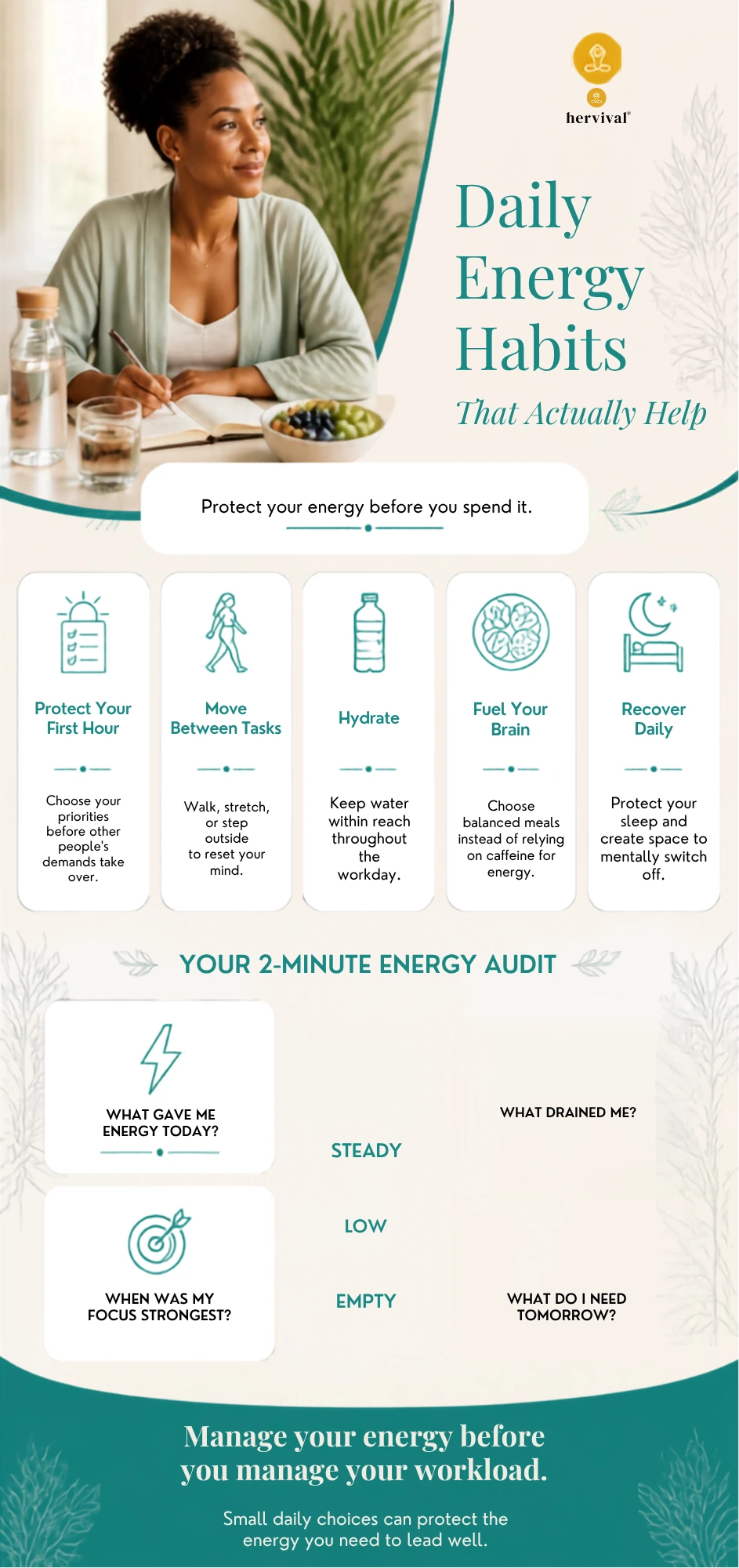
You don't need an elaborate wellness routine to begin.
Start with small changes.
Protect Your First Hour
Instead of immediately opening an email and responding to everyone else's priorities, give yourself a few minutes to identify your own priorities.
Ask:
What requires my best thinking today?
Build Recovery Into Your Calendar
Don't wait until you're completely exhausted before taking a break.
Schedule short periods to step away, breathe, walk, stretch, or simply sit without another demand competing for your attention.
Recovery is part of performance.
Eat for Consistent Energy
Your brain depends on adequate nourishment.
Instead of relying heavily on caffeine or sugary snacks, build meals around protein, vegetables, whole foods, healthy fats, and adequate hydration.
Your nutrition serves as the biological foundation for your leadership capacity. To learn more about how your digestive health directly influences your cognitive performance, emotional stability, and focus, read our related article: Gut Health for Leaders: Why Your Brain Depends on Your Gut.
Reduce Unnecessary Context Switching
Every time you jump from a strategy document to Slack, from Slack to email, and then into a meeting, your attention has to adjust.
Batch similar tasks where possible.
Your brain will thank you.
Create Meeting Recovery Gaps
If you have five meetings in a row, your calendar may look efficient while your brain feels completely overwhelmed.
Even a 10-minute transition period can give you time to reset before entering another conversation.
Leadership Recovery Is Not Wasted Time
One of the most important principles of leadership resilience is recovery.
We often celebrate leaders who can withstand enormous pressure.
But sustainable leaders also know when to step back.
Recovery can look like:
Taking a walk outside
Getting enough sleep
Spending time with people who make you feel grounded
Practicing mindfulness
Journaling
Exercising
Eating a proper meal away from your desk
Taking a vacation without turning it into a remote-work opportunity
The goal isn't to escape responsibility.
The goal is to return with the capacity to handle it.
This connects directly with Leadership Without Burnout: Choosing Wholeness Over Exhaustion, where we explore why sustainable leadership requires more than simply surviving demanding seasons.
Your Energy Audit: Find Out What Is Really Draining You
Before changing your routine, spend one week observing it.
At the end of each workday, ask yourself:
What gave me energy today?
Perhaps it was:
A meaningful conversation
Creative work
Exercise
Time outdoors
Completing an important project
What drained me?
Perhaps it was:
Back-to-back meetings
Constant notifications
Difficult conversations
Skipping lunch
Working late
When was I most focused?
Was it early morning?
Late morning?
Afternoon?
When did my energy drop?
Look for patterns rather than judging yourself.
You may discover that your problem isn't that you don't have enough time.
You may simply be spending your best energy on the wrong things.
Energy Management vs. Time Management
The difference becomes clearer when you put the two approaches side by side.
Time Management | Energy Management |
|---|---|
How much time do I have? | How much capacity do I have? |
What fits into my calendar? | What deserves my best energy? |
How can I do more? | What actually matters? |
How can I eliminate wasted time? | What consistently drains me? |
How can I stay busy? | How can I remain effective? |
How can I maximize my schedule? | How can I sustain my performance? |
Neither approach is useless.
Time management helps you organize your commitments.
Energy management helps you determine how you will show up for those commitments.
You need both.
Healthy Leadership Habits Begin With Capacity
A leader who understands their capacity is better positioned to create healthy boundaries.
That might mean saying:
"I can't take that on this week."
Or:
"Let's move this conversation to tomorrow so I can give it the attention it deserves."
Or:
"I need some recovery time before making this decision."
These statements are not signs of weak leadership.
They demonstrate self-awareness.
Healthy leadership habits include knowing when to push forward and when to pause.
They also create a healthier example for the people watching you.
When leaders normalize breaks, boundaries, recovery, and realistic workloads, employees receive permission to protect their own wellbeing too.
Sustainable Leadership Requires a Sustainable Rhythm
There will always be seasons when leadership demands more.
A product launch may require longer hours.
A crisis may require immediate attention.
A major organizational change may stretch everyone's capacity.
Sustainable leadership does not mean avoiding difficult seasons.
It means ensuring that intense periods are followed by recovery rather than becoming the permanent operating system.
Think of leadership as a rhythm:
Focus → Effort → Recovery → Reflection → Renewed Focus
Not:
Work → Work → Work → Exhaustion → Repeat.
That difference can determine whether success remains sustainable.
The Goal Is Not More Energy. It Is Better-Directed Energy.
You don't need to wake up every morning feeling endlessly energized.
That's unrealistic.
You need to become more intentional about where your energy goes.
Some activities deserve your full attention.
Some can be delegated.
Some can be automated.
Some can wait.
And some should disappear from your schedule altogether.
This is where leadership resilience becomes practical.
Resilience isn't about having unlimited capacity.
It is about knowing how to use, protect, and restore your capacity.
A More Sustainable Way to Lead
Imagine ending your workday knowing that you gave your most important responsibilities your best attention without completely emptying yourself.
You still have enough energy to have dinner with your family.
Enough patience to listen.
Enough mental space to enjoy your evening.
Enough physical capacity to move your body.
Enough emotional room to simply be yourself.
That is what sustainable leadership can look like.
Energy Management for Leaders is ultimately about moving from "How much more can I fit into this day?" to:
"What kind of energy do I want to bring to the life and leadership I am building?"
Leadership is not only about what you accomplish at work.
It is also about whether you still have something left when the workday ends.
Reflection
Your calendar can tell you where your time went.
Your energy tells you what that time actually cost.
Start paying attention to both.
The goal isn't to become endlessly productive. It is to become a leader who can think clearly, respond thoughtfully, recover intentionally, and keep showing up without constantly running on empty.
You don't need to manage every minute perfectly. You need to protect the energy that makes those minutes meaningful.
Stay Connected With Hervival
At Hervival, we believe sustainable leadership begins with sustainable wellbeing.
Subscribe to the Hervival Newsletter for practical insights on leadership wellness, emotional resilience, nutrition, workplace wellbeing, and healthier ways to build a meaningful career without sacrificing yourself in the process.

Become a part of Our Holistic Wellness & Self-Care Community! Join our membership TODAY!
