
The Regulated Leader: Why Emotional Stability Defines Modern Leadership
The Regulated Leader understands that leadership is not tested during calm moments; it is revealed during uncertainty, conflict, and pressure.
In today's fast-moving workplaces, many leaders have been taught that success comes from pushing harder, responding faster, and staying constantly available.
Yet the leaders who create lasting impact are often the ones who pause before reacting, remain grounded during challenges, and make thoughtful decisions even when emotions run high.
For many women leaders, especially those balancing professional demands with caregiving responsibilities and community expectations, leadership has historically required overperforming, emotional labor, and functioning in survival mode.
But leadership is evolving.
The future belongs not to the busiest leader in the room, but to the most regulated one.
This growing conversation around emotional sustainability builds on our exploration of Emotional Regulation Tools for High-Pressure Leaders, where we discuss practical strategies leaders can use to remain grounded during periods of uncertainty and change.
Why Regulated Leader Matters More Than Ever
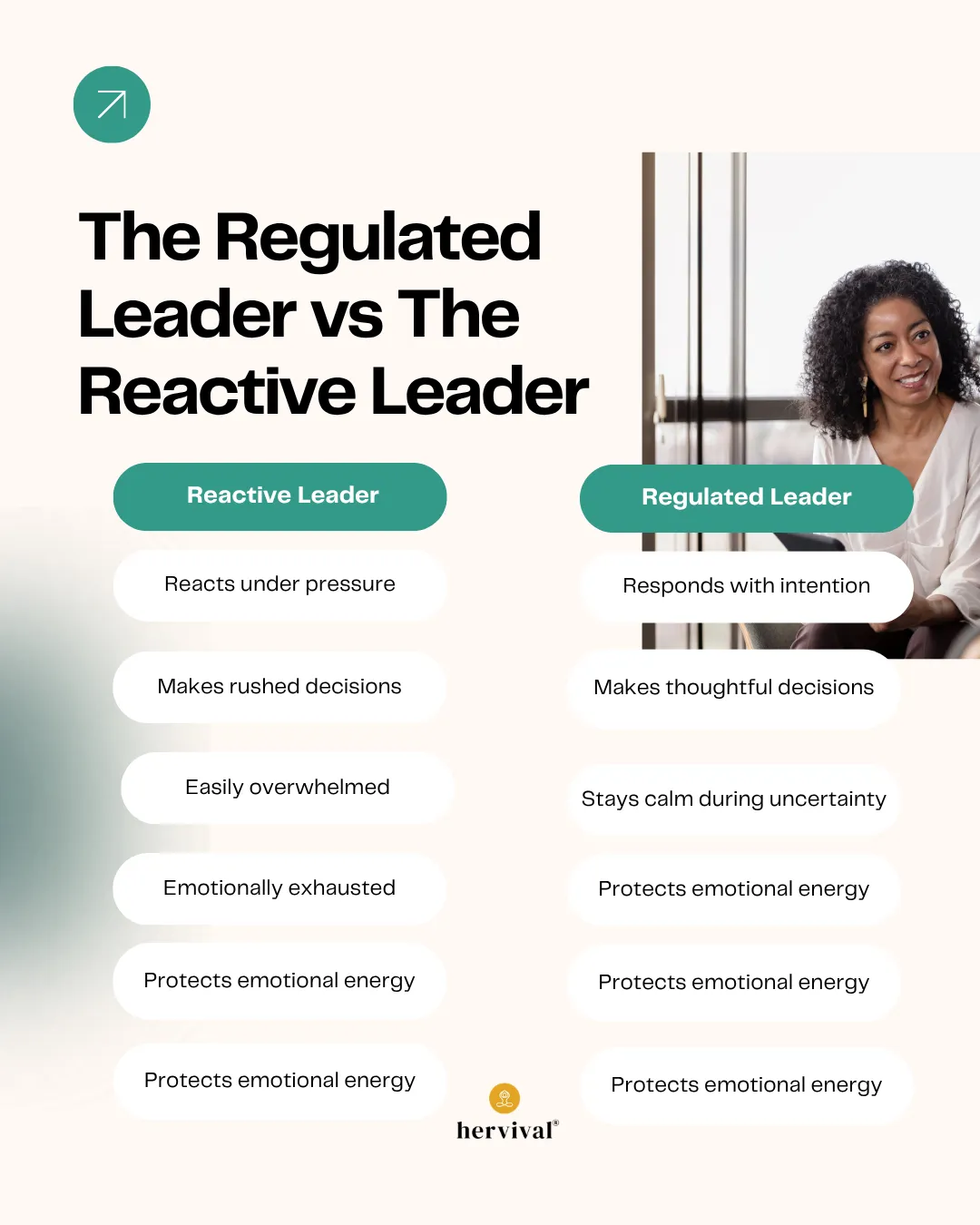
Leadership today requires far more than technical expertise.
Teams look to leaders for clarity during uncertainty, emotional steadiness during change, and empathy during difficult conversations.
Research increasingly shows that chronic stress impairs cognitive flexibility, emotional control, and decision-making quality. When the nervous system remains in a constant state of fight-or-flight, leaders are more likely to:
React impulsively instead of responding intentionally
Struggle with focus and strategic thinking
Experience emotional exhaustion
Communicate less effectively
Make decisions based on urgency rather than long-term vision
Conversely, leaders who prioritize emotional wellbeing in leadership are better equipped to navigate complexity, inspire trust, and foster healthier workplace cultures.
Calm is not a personality trait.
It is a leadership skill.
Sleep also plays a critical role in maintaining emotional regulation and cognitive performance. In Poor Sleep and Leadership: How Rest Impacts Decision-Making, we explore how insufficient rest affects judgment, focus, and workplace effectiveness.
The Science Behind Regulation and Leadership
Emotional regulation is the ability to recognize emotions, manage stress responses, and choose actions intentionally rather than react automatically.
When leaders experience high pressure, the brain's threat detection system activates rapidly. While this response is designed to protect us, prolonged activation can reduce activity in the prefrontal cortex, the area responsible for critical thinking, planning, and sound judgment.
This is why stress can make even experienced leaders:
Misinterpret feedback
Overreact during conflict
Avoid difficult decisions
Become mentally fatigued
Developing emotional resilience at work helps restore balance between emotional reactions and thoughtful decision-making.
Regulation does not mean suppressing emotions.
It means creating enough space to respond wisely.
This connection between stress, emotions, and leadership performance is also explored in Leadership and Stress Hormones: Why Regulated Minds Lead Better, which examines how chronic stress affects the brain and decision-making processes.
Signs You May Need to Become a More Regulated
Many high-performing professionals normalize stress until it begins affecting their leadership effectiveness.
You may benefit from stronger stress management for leaders if you notice:
Feeling constantly overwhelmed
Difficulty concentrating during meetings
Responding defensively to feedback
Experiencing frequent irritability
Struggling to disconnect after work
Making decisions from a place of urgency
Feeling emotionally depleted despite achievement
These experiences are not signs of weakness.
They are signals from your mind and body that recovery is needed.
The Regulated Leader Prioritizes the Nervous System
Leadership development often focuses on communication frameworks, productivity tools, and strategic planning.
But sustainable leadership starts with nervous system awareness.
When leaders feel safe, grounded, and emotionally balanced, they are more capable of:
Listening actively
Navigating conflict effectively
Building trust
Thinking creatively
Making values-aligned decisions
This is why mindful practices are becoming essential rather than optional.
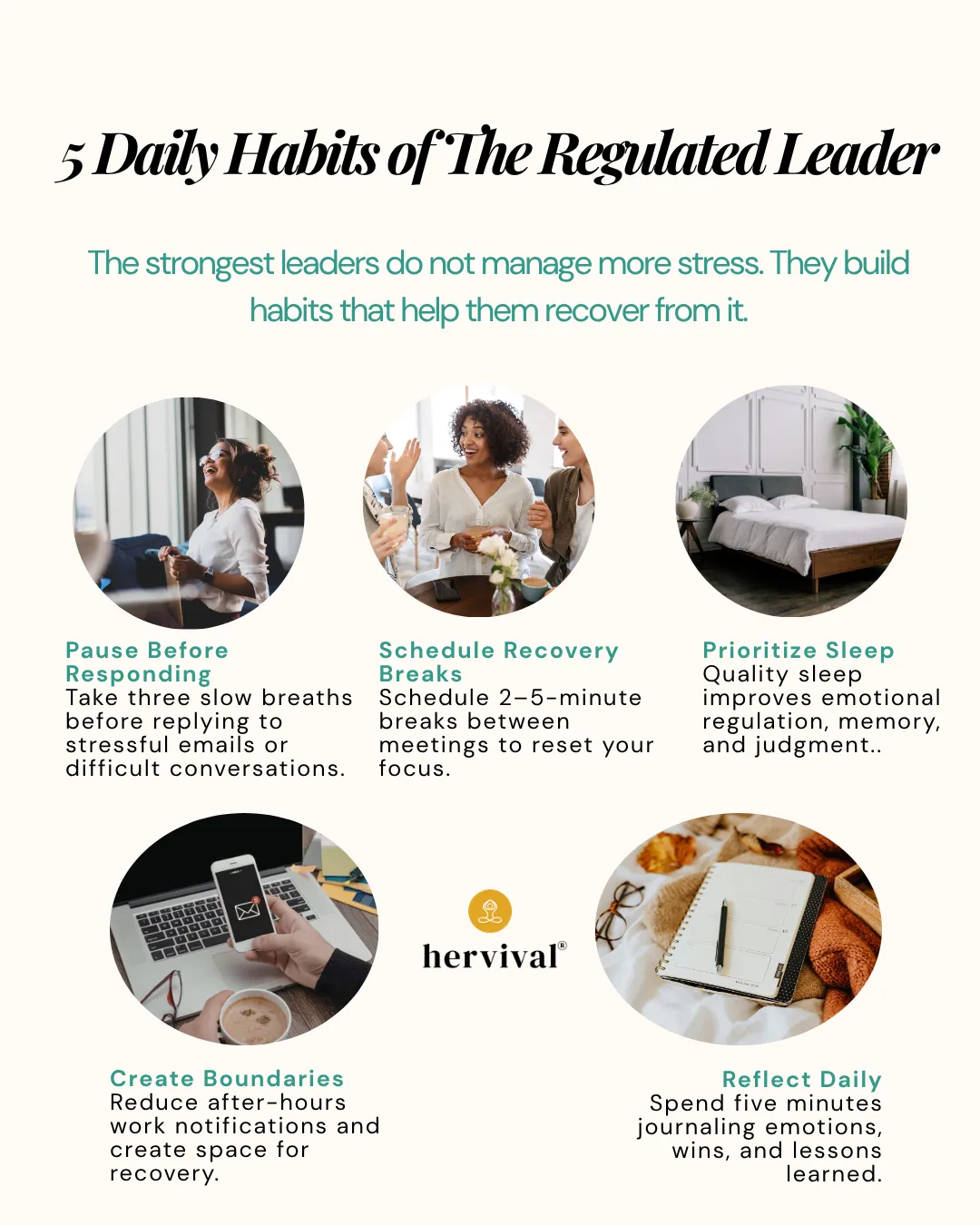
Simple daily practices can make a meaningful difference.
Try these regulation tools:
Take three deep breaths before responding to challenging messages
Schedule short recovery breaks between meetings
Pause before making high-stakes decisions
Practice body awareness to identify tension
Step outside for fresh air during stressful moments
Use reflective journaling to process emotions
Small pauses create better outcomes.
Leadership Without Burnout Starts With Recovery
For too long, leadership has been associated with sacrifice.
Late nights, skipped meals, constant availability, and exhaustion have been treated as signs of commitment.
But leadership without burnout requires redefining success.
Recovery is not separate from performance; it fuels it.
Leaders who prioritize rest tend to demonstrate:
Better emotional regulation
Improved creativity
Stronger communication skills
Greater resilience during change
More consistent decision-making
Consider incorporating recovery practices such as:
Protecting your sleep schedule
Setting digital boundaries
Taking movement breaks throughout the day
Creating screen-free moments
Scheduling time for reflection and hobbies
Sustainable success is built through rhythms of effort and recovery.
How The Regulated Leader Shapes Workplace Culture
Leadership behavior is contagious.
When leaders operate from chronic stress, teams often mirror that energy.
When leaders model emotional awareness, healthy boundaries, and intentional communication, workplaces become more resilient.
Regulated leader creates cultures where:
Wellbeing is valued alongside performance
Psychological safety is prioritized
Rest is respected
Feedback is delivered with empathy
People feel supported during challenges
Organizations increasingly recognize that wellness is not separate from business outcomes.
It drives them.
In fact, this reflects a larger shift explored in Wellness Is the New Leadership Currency for Sustainable Success, where we discuss why wellbeing has become one of the most valuable leadership assets in modern workplaces.
Looking Back
The most influential leaders are not the ones who never experience stress.
They are the ones who know how to regulate it.
Regulated Leader understands that emotional steadiness is a competitive advantage, rest is a leadership strategy, and wellbeing is foundational to long-term success.
Because in a world that rewards urgency, calm is a powerful form of leadership.
And the leaders who learn to regulate themselves will be the ones who shape healthier workplaces, stronger teams, and more sustainable futures.
Stay Connected With Hervival
If this reflection spoke to you, subscribe to the Hervival Newsletter.
Each edition delivers practical insights on leadership wellness, emotional resilience, sustainable success, and everyday habits that help women thrive, without sacrificing their wellbeing.
Join the Hervival community and receive supportive resources designed to help you lead with clarity, purpose, and balance.
Research & References
American Psychological Association. Work and Well-Being Survey.
World Health Organization. Mental Health at Work (2022).
Gross, J. J. (2015). Emotion Regulation: Current Status and Future Prospects. Psychological Inquiry, 26(1), 1–26.
Davidson, R. J., & McEwen, B. S. (2012). Social Influences on Neuroplasticity and Wellbeing. Nature Neuroscience, 15(5), 689–695.
Goleman, D. (1998). Working with Emotional Intelligence.


