
Leadership and Stress Hormones: Why Regulated Minds Win
Leadership and stress hormones are deeply connected, yet often overlooked in conversations about performance and success.
Most leadership advice focuses on strategy, communication, and productivity. But behind every decision, every reaction, and every interaction is something more fundamental: your physiological state.
When stress hormones like cortisol rise, your body shifts into survival mode.
And when that happens, leadership changes, often without you realizing it.
Instead of thoughtful responses, you may notice:
Faster reactions
Shorter patience
Reduced clarity
Emotional tension in conversations
This is not a failure of discipline.
It is a biological response.
How Stress Hormones Shape Leadership Behavior
To understand leadership and stress hormones, we need to understand what happens internally.
When you experience pressure, tight deadlines, difficult conversations, and high expectations, your body releases cortisol and adrenaline.
These hormones are helpful in short bursts.
They increase alertness and help you act quickly.
However, when stress becomes constant:
The brain prioritizes survival over strategy
The prefrontal cortex (responsible for decision-making) becomes less active
Emotional reactivity increases
This means you may:
Make rushed decisions instead of thoughtful ones
Struggle to process complex information
React emotionally rather than respond intentionally
Research from Harvard Health Publishing shows that chronic stress can impair memory, focus, and emotional regulation, all of which are essential for effective leadership.
Leadership and Stress Hormones Affect Your Presence
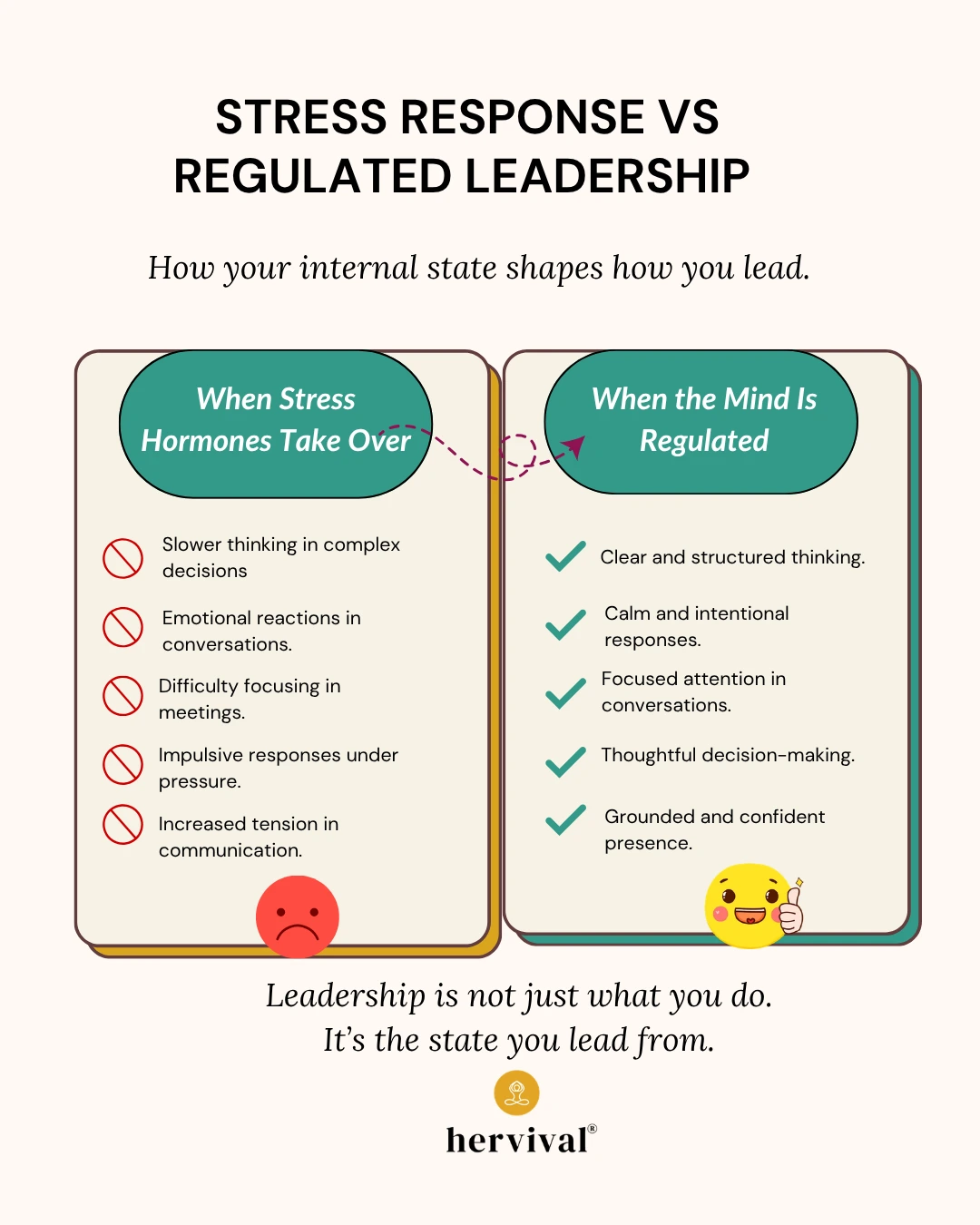
Leadership is not only about what you say.
It is about how you show up.
When stress hormones are elevated, your presence shifts in subtle but powerful ways:
Your tone may become sharper
Your body language may appear tense
Your ability to listen may decrease
Even if your words are right, your energy can feel different to others.
On the other hand, regulated leaders:
Create psychological safety
Communicate with clarity
Maintain calm during uncertainty
This aligns with Leading with Empathy: Creating Emotional Safety at Work, where emotional steadiness strengthens trust and connection.
Why Regulated Minds Lead Better
At the core of leadership and stress hormones is one key idea: regulation creates access to better thinking.
When your nervous system is regulated:
The brain can process information more effectively
Emotions become easier to manage
Decisions become more aligned and less reactive
Instead of operating from urgency, you lead from awareness.
This is what allows leaders to:
Pause before responding
Navigate conflict with clarity
Stay grounded under pressure
Regulation does not remove challenges.
It changes how you meet them.
Practical Ways to Regulate Stress in Leadership
You don’t need extreme changes to improve leadership and stress hormones.
Small, consistent practices can significantly shift your internal state.
1. Pause Before Responding
When tension rises, create a brief pause.
Even a few seconds can:
Interrupt reactive patterns
Allow your brain to reset
Create space for a thoughtful response
2. Use Breathing to Reset Your Nervous System
Simple breathing techniques can lower cortisol levels.
Try:
Slow inhale for 4 seconds
Hold for 4 seconds
Exhale for 6 seconds
This signals safety to your body.
3. Identify Emotional Triggers
Awareness reduces reactivity.
Notice:
What situations elevate your stress
When your responses feel rushed or intense
This connects with Journaling for Self-Discovery: Prompts to Know Yourself, where reflection builds emotional clarity.
4. Build Micro-Recovery Moments
You don’t need long breaks to reset.
Short pauses between meetings can:
Reduce mental fatigue
Improve focus
Stabilize emotional responses
5. Support Your Body Through Lifestyle Choices
Your physiology directly affects your leadership.
Simple habits like:
Consistent sleep
Balanced nutrition
Reduced caffeine during high stress
help regulate stress hormones naturally.
You can explore this further in Mindfulness for Busy Professionals: 5-Minute Habits That Work where sensory tools support emotional balance.
From Reactivity to Intentional Leadership
The difference between reactive and regulated leadership is not experience.
It is awareness and practice.
Reactive leadership looks like:
Immediate responses
Emotional escalation
Decision fatigue
Regulated leadership looks like:
Thoughtful pauses
Clear communication
Sustainable energy
This shift does not happen overnight.
But it begins with noticing your internal state.
A New Perspective on Leadership Strength
For a long time, leadership strength has been associated with endurance, pushing through pressure without slowing down.
But leadership and stress hormones reveal a different truth.
Strength is not:
Constant urgency
Emotional suppression
Continuous output
Strength is:
Regulation
Awareness
Sustainability
Because the leaders who endure are not the ones who push the hardest.
They are the ones who recover, regulate, and respond with intention.
Final Reflection
Leadership and stress hormones remind us that leadership is not just external, it is deeply internal.
How you think, respond, and lead is shaped by how well your mind and body are supported.
And when you learn to regulate your internal state, you don’t just become a calmer leader, you become a more effective one.
Stay Connected With Hervival
If this resonated with you, you’re invited to subscribe to the Hervival Newsletter.
Inside, you’ll receive:
Practical tools for emotional regulation
Wellness strategies for modern leadership
Insights to help you lead without burnout
Because better leadership doesn’t start with doing more, it starts with being regulated, supported, and well.
References
Harvard Health Publishing. (2020). Understanding the stress response.
McEwen, B. S. (2017). Neurobiological and systemic effects of chronic stress. Nature Medicine.
American Psychological Association. (2023). Stress in America Survey.


